Every company is about to hire a new kind of employee. It never sleeps, never complains — and it will do exactly what you tell it, even when you tell it the wrong thing.
[IMAGE 3 — header]
That new employee is the AI agent. And 2026 is the year it moved from experiment to everyday work.
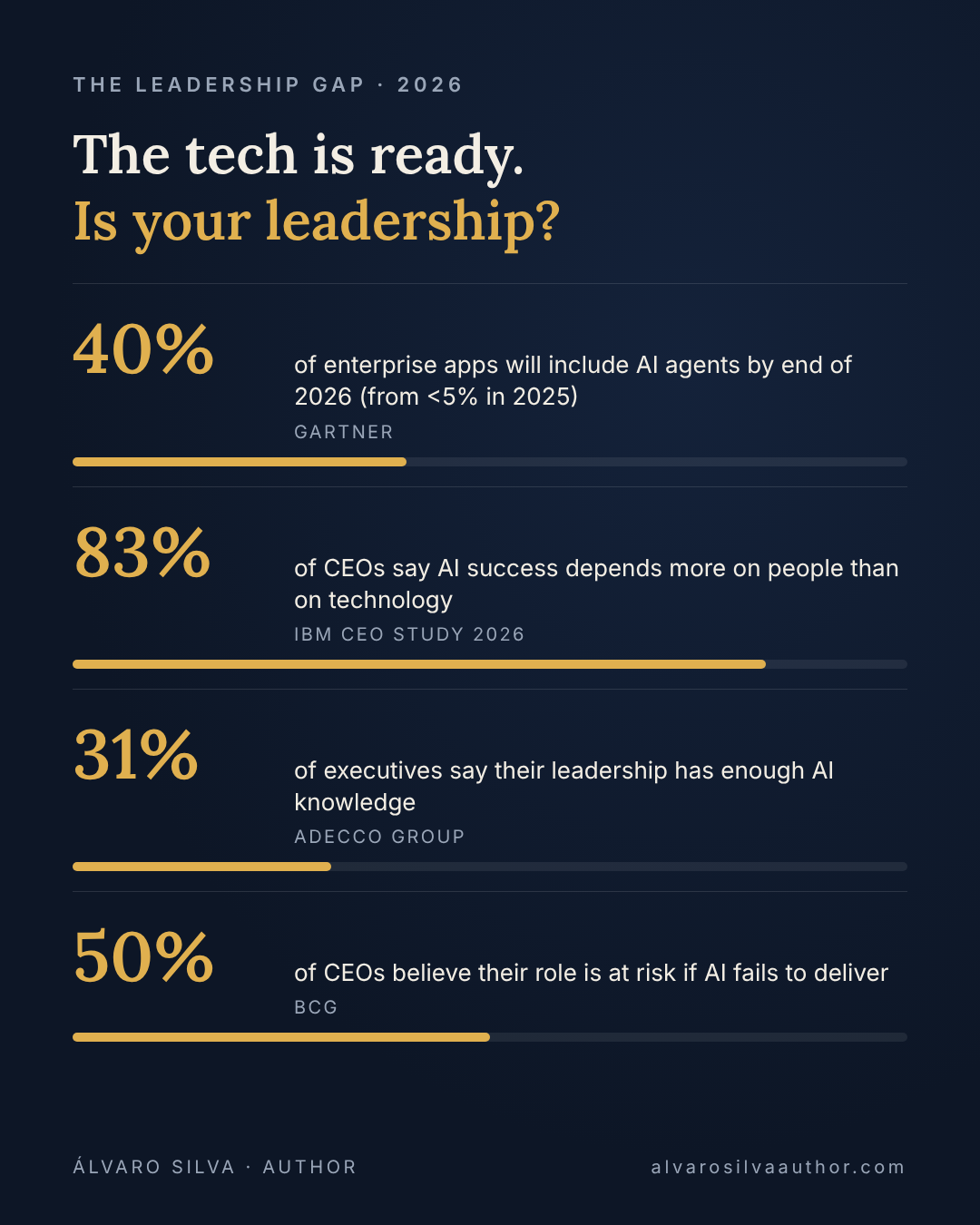
Gartner expects 40% of enterprise applications to include task-specific AI agents by the end of 2026. One year earlier, the number was below 5%. Companies are doubling their AI budgets to keep up.
But there is a quiet problem behind the headlines. Most organizations are adopting agents faster than they are learning to lead them.
The numbers behind the leadership gap
[IMAGE 4 — infographic]
83% of CEOs say AI success depends more on people's adoption than on technology (IBM, 2026 CEO Study).
Only 31% of executives believe their leadership team has enough AI knowledge to understand the risks and opportunities (Adecco Group).
50% of CEOs believe their own role is at risk if AI doesn't deliver results (BCG).
More than 40% of agentic AI projects are at risk of cancellation by 2027 (Gartner).
The technology is ready. The question is whether the leadership is.
What makes an AI agent different from a tool
A tool waits for you. An agent acts for you.
It can read a customer request, check your systems, decide what to do and do it — without anyone clicking a button. That is powerful. It is also a responsibility. Every agent you deploy carries a piece of your strategy, your values and your judgment into thousands of small decisions.
That is why leading AI agents is not an IT project. It is a leadership discipline.
A 5-layer framework for leading hybrid teams
The leaders who get results with AI don't start with the technology. They build in layers, from people to execution.
1. Human intelligence: start with your people
Before any rollout, answer the question every employee is silently asking: "What happens to me?" Explain what changes, what stays and how each role grows. Fear blocks adoption faster than any technical problem.
2. Strategic intelligence: give agents a clear goal
An agent optimizes whatever you point it at. If your strategy is unclear, your agents will automate the confusion. Write one sentence: "We use AI agents to…" and make sure the whole team can repeat it.
3. Data intelligence: clean the fuel
Agents decide with the data you give them. Poor, scattered or outdated data produces confident wrong answers. Fix the data before you scale the agents.
4. AI intelligence: set the limits
Decide which decisions an agent can take alone, which need human approval and which always stay human. Clear limits are what turn a risky experiment into a trusted teammate.
5. Execution intelligence: measure and adjust
Track productivity, but also trust, adoption and engagement. The best indicator of success is a team that uses agents willingly, not one that is forced to.
Three mistakes to avoid
Buying before defining. Choosing a platform before you know what problem it solves.
Delegating AI to IT alone. Goals, limits and culture belong to the leadership team.
Announcing instead of involving. A rollout email is not change management. Conversations are.
The real advantage in the agent era
Soon every company will have access to the same AI agents. The technology will not be the difference.
The difference will be leaders who can combine human, strategic and artificial intelligence — and teams that grow united toward the same goal.
AI scales what you already are. Make sure it is clarity, not chaos.
Want to go deeper? The five layers in this guide come from my book CEO Intelligence Stack™ + AI, written for leaders who are implementing AI in their companies. See it on Amazon · All my books
Follow me on Instagram and read more articles on the blog. · alvarosilvaauthor.com