Picture a used e-bike for sale. It looks almost new. The battery, the most expensive part, could be at 95% of its original capacity or at 60%. Today, nobody can tell by looking.
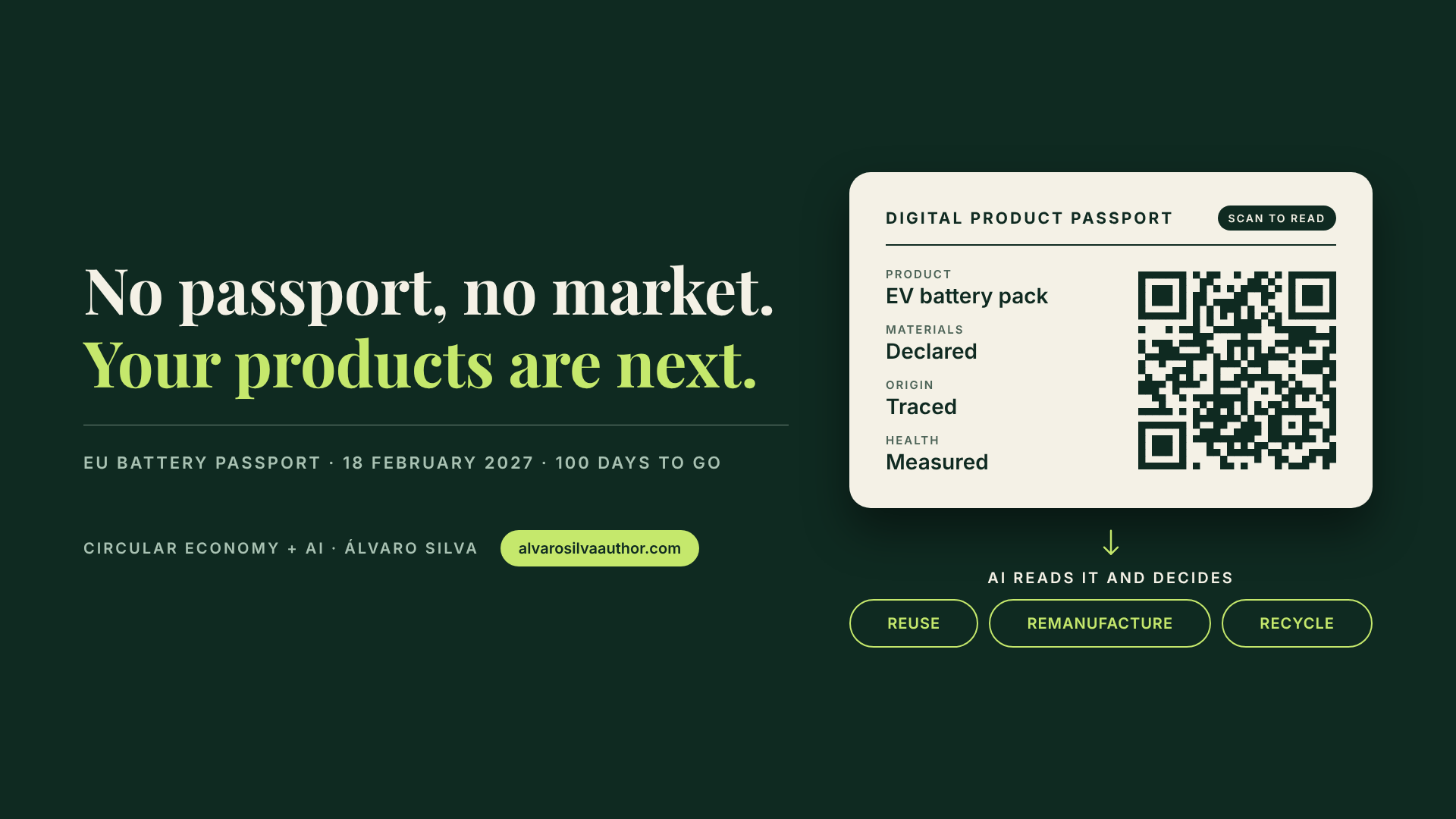
Now picture scanning a QR code on that battery and reading its story: who made it, what it is made of, how it has aged.
That second scene starts becoming real on 18 February 2027, when the EU battery passport becomes mandatory for electric-vehicle batteries, batteries for e-bikes and e-scooters, and industrial batteries above 2 kWh.
It is the first Digital Product Passport to come into force. It will not be the last.
What a product passport is
A Digital Product Passport is a structured digital record that travels with a product through its life. A data carrier on the product, usually a QR code, links to information about how it was made, what it contains, and how to repair, reuse or recycle it.
The passport is not stored in one giant European database. The code points to data that the company maintains, and an EU registry keeps the index.
The calendar so far
20 July 2026: the EU Digital Product Passport registry became operational.
18 February 2027: battery passport mandatory for EV, light-transport and industrial batteries above 2 kWh.
2027 (expected): passport rules for textiles adopted, with obligations applying after a transition period.
2029: detergent passport.
2030: toy passport.
Iron and steel, aluminium, tyres and furniture are also on the EU's priority list.
The pattern matters more than any single date. Product by product, physical goods are being asked to carry verified data.
Why this is good news for the circular economy
Only 6.9% of the materials that enter the global economy are secondary materials. The Circularity Gap Report 2026 estimates that linear practices destroy around €25.4 trillion in value each year.
Much of that loss is an information problem. A recycler who does not know what is inside a product treats it as mixed waste. A buyer who cannot verify condition pays a scrap price. A manufacturer who never sees the product again cannot learn from it.
The passport supplies the information. AI makes it useful at scale.
Five moves to make now
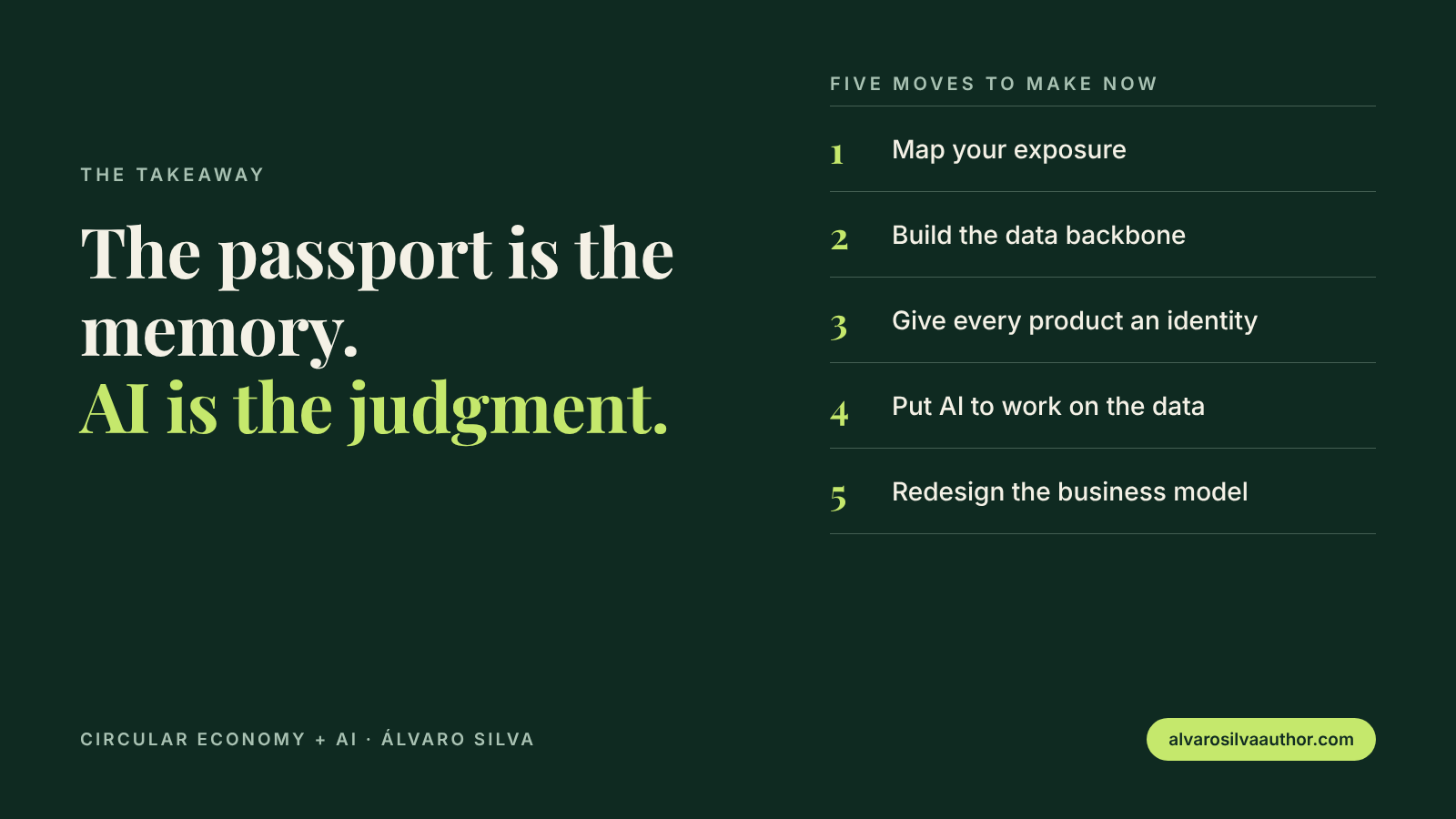
1. Map your exposure. List every product line, the markets it reaches and the passport rules that will touch it. Include the indirect route: if your customer sells into the EU, they will ask you for the data.
2. Build the data backbone. Bill of materials, supplier origin, composition, repair instructions. In most companies this lives in PDFs, spreadsheets and inboxes. AI tools can extract it, structure it and flag the gaps, so your team reviews exceptions and stops retyping documents.
3. Give every product an identity. A passport needs a unique identifier and a data carrier on the product. Decide early whether you identify by model, by batch or by individual item, because that choice defines what you can do with the data later.
4. Put AI to work on the data. This is where compliance becomes strategy. Models can estimate the remaining life of a component, recommend reuse, remanufacturing or recycling for each unit, price residual value, and send field data back to designers so the next version lasts longer.
5. Redesign the business model. Once you know where your products are and what condition they are in, take-back programs, certified resale, leasing and product-as-a-service stop being experiments and start being forecastable revenue.
Two cautions
AI is only as good as the data it reads. A passport filled with estimates and copy-paste produces confident wrong answers. Verify at the source.
And responsibility does not transfer to software. For batteries, the obligation sits with the company that places the finished battery on the market, whoever builds the system behind it.
The takeaway
For two centuries, products left the factory and disappeared from view. The passport gives them a memory. AI gives that memory a use.
Companies that start now will meet the deadline. Companies that start with the right question, "what can we do with this data?", will find a new business inside the old one.
Sources
Not part of the published text. Checked on 10 November 2026.
European Commission: Digital Product Passport for batteries: scope, 18 February 2027 date, registry operational 20 July 2026, who is responsible.
EU Digital Product Passport updates: access-rights act missed its 18 August 2026 deadline: the February date is unconditional.
Greensutra: has the DPP been delayed?: fixed dates for batteries, detergents (2029) and toys (2030).
osapiens: ESPR overview: priority product groups (iron and steel, textiles, aluminium, tyres, furniture).
Projet Celsius: digital product passport explained: how the passport and registry work; textiles timing.
Deloitte: Global Circularity Gap Report 2026: 6.9% circularity and the €25.4 trillion Value Gap.
Álvaro Silva | Author and entrepreneur
Circular economy · Artificial intelligence · Innovation · Business strategy · Sustainability
Website · More articles on the blog · Books on Amazon · Instagram · Goodreads